
At ROMA Arquitectura Studio, we specialise in the architectural design and meticulous execution of bespoke, luxury private swimming pools in Marbella and Sotogrande. We believe that building a high-end aquatic wellness space should be a seamless experience, which is why we offer a comprehensive turnkey service. Our practice manages the entire process from initial concept to final handover.
Beyond achieving exceptional aesthetic and technical standards, we handle all legal, planning, and regulatory requirements to ensure strict compliance with local building codes, entirely removing the typical complications of construction and delivering a flawless result with zero effort and total peace of mind for our international clients.
Our ultimate goal is to translate your ideas and personal style into reality, allowing you simply to arrive and enjoy the exceptional Mediterranean climate and refined outdoor living of the Costa del Sol in your brand-new pool.
Designing a swimming pool for a luxury residence in Marbella or Sotogrande requires a deep understanding of the property’s unique context. We approach each private pool as an architectural extension, carefully harmonising its design with the villa style, landscape, orientation, and the distinct lifestyle of its owners.
Skimmer swimming pools represent a highly reliable and traditional approach to aquatic design, where the water level sits slightly below the coping. This system is particularly well suited to classic Mediterranean architectural styles, offering a robust and technically straightforward solution.
The primary benefits include simplified maintenance, reduced installation complexity, and reliable, well-established water circulation technology. While highly functional for daily swimming, modern architectural detailing allows skimmer pools to blend seamlessly into refined outdoor spaces.
By using concealed skimmer covers and carefully selected or tailored natural stone copings, this traditional typology achieves a clean, elegant aesthetic that prioritises functionality without compromising the property’s design integrity.

The specification of a skimmer pool in contemporary high-end residential architecture offers a practical and aesthetically considered solution, particularly suited to enclosed courtyards, rectilinear layouts and traditional Mediterranean settings. Unlike overflow systems, a skimmer pool maintains its water level below the surrounding paving, typically by approximately 100–150 mm. This difference in height creates a clearly defined edge between the pool and the adjacent terrace, allowing the design to incorporate carefully detailed stone copings. These can project slightly over the pool walls, concealing the waterline tiling and creating a subtle shadow across the water’s surface. The resulting composition reinforces the pool’s geometric character and establishes a strong visual relationship with the surrounding outdoor spaces.
From a construction perspective, skimmer pools generally require less complex perimeter detailing and hydraulic infrastructure than overflow alternatives. Water is collected through skimmer openings integrated into the pool walls, eliminating the need for continuous overflow channels and separate balance tanks. This simplified arrangement can reduce construction complexity, maintenance requirements and associated costs, although structural stability remains dependent on appropriate ground conditions, engineering design and construction quality.
ROMA Arquitectura Studio, luxury skimmers swimming pool architects in Marbella & Sotogrande
Contemporary detailing has also refined the integration of skimmer systems within modern residential architecture. Concealed or discreetly positioned skimmer fittings minimise the visual impact of conventional plastic components, while carefully coordinated stone copings and paving allow the filtration openings to blend into the surrounding finishes. This attention to detail preserves the clarity of the pool’s geometry and ensures a cohesive relationship with the exterior architecture.
Skimmer pools can also offer certain advantages in terms of energy efficiency. By avoiding the continuous circulation of water over a perimeter edge, they may reduce some of the heat loss and evaporation associated with overflow systems, particularly where the latter incorporate exposed collection channels. When combined with an appropriately specified aerothermal heating system, efficient filtration equipment and a suitable pool cover, this arrangement can contribute to more effective temperature management and lower energy consumption.
With carefully selected materials, precisely detailed stonework and discreetly integrated filtration components, the skimmer pool becomes a refined architectural feature that combines straightforward construction, reliable operation and a clean, understated appearance. Its clearly defined perimeter and restrained geometry make it particularly well suited to contemporary luxury villas, where the relationship between water, paving and built form is central to the overall landscape design.
ROMA Arquitectura Studio, luxury skimmer swimming pools architects in Sotogrande, San Roque, Marbella, Estepona, Benahavis, Malaga.
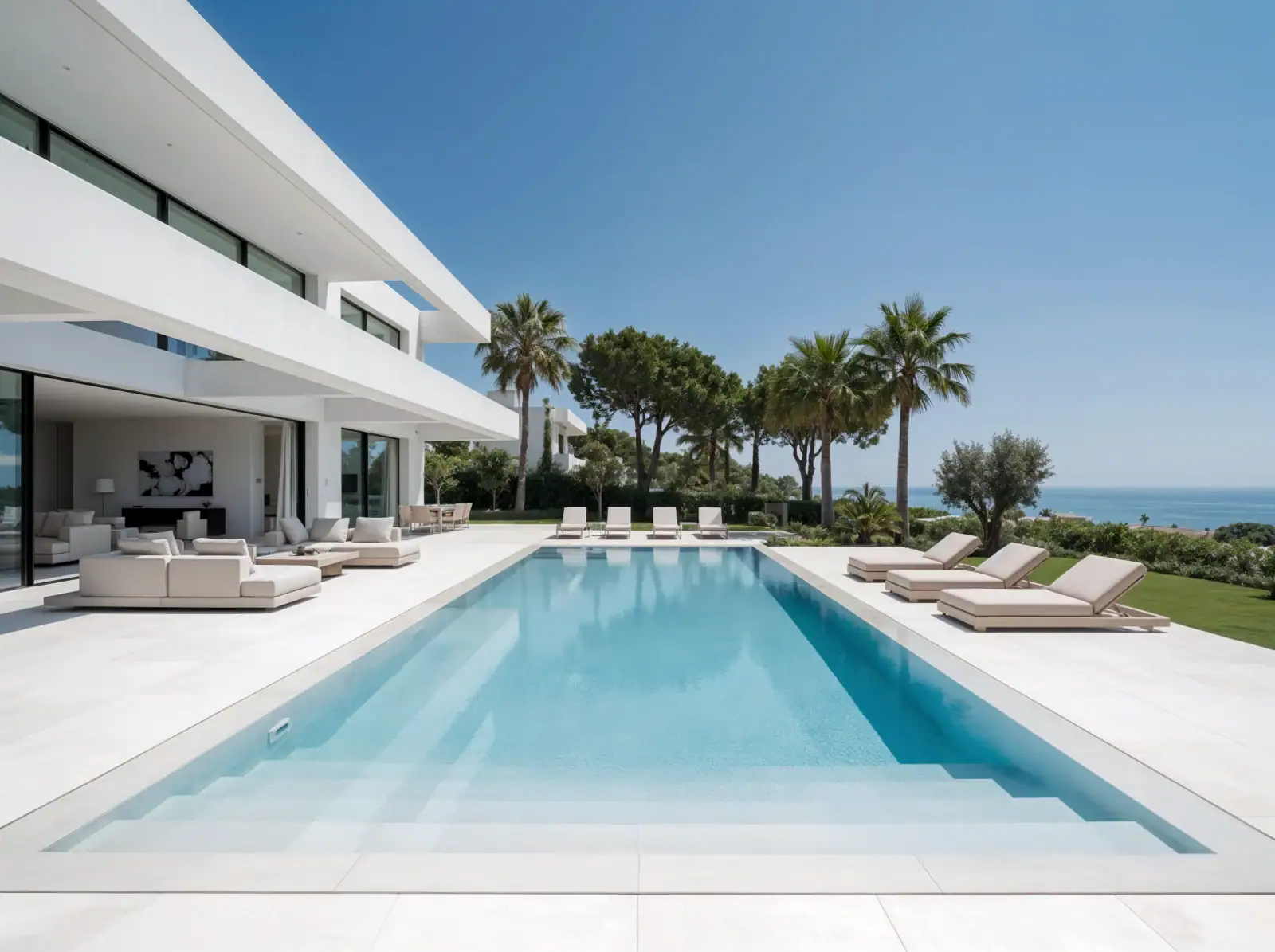
Overflow pools create a striking visual effect as water flows continuously over the edge into a discreet perimeter channel. A highly refined version is the zero-edge pool, where the water level sits perfectly flush with the surrounding paving to achieve a total mirror effect. Inherently aligned with contemporary minimalist architecture, this type of swimming pool establishes a pristine surface that flawlessly reflects the landscape and sky.
The main advantages lie in its aesthetic purity and enhanced water cleanliness, as the continuous overflow efficiently removes floating debris and surface impurities.
Primarily conceived for high-end visual impact and sophisticated entertaining, overflow pools enhance outdoor spaces, providing an immaculate architectural environment that elevates the indoor-outdoor living experience of any luxury coastal property.
Overflow pool systems, also known as deck-level or perimeter overflow pools, are designed to establish a seamless visual connection between the water surface and the surrounding architectural paving. By maintaining the water level flush with the adjacent terrace, the pool becomes an integral part of the exterior composition rather than a visually enclosed element. Its reflective surface creates a continuous horizontal plane that reinforces the relationship between the architecture, landscape and outdoor living areas.
Achieving this effect requires particularly precise construction and careful coordination between the structural shell, waterproofing and perimeter finishes. The overflow edge must be accurately levelled to ensure an even distribution of water around the pool. Any significant variation in height can result in irregular overflow patterns, compromising both the hydraulic performance and the visual consistency of the water surface.
The system operates by allowing water to flow continuously over the perimeter edge into a concealed collection channel. From there, it is directed to a balance tank before passing through the filtration, treatment and heating systems and returning to the pool. This arrangement accommodates variations in water volume while maintaining a consistent surface level.
ROMA Arquitectura Studio, luxury overflow swimming pool architects in Sotogrande & Marbella
One of the principal architectural considerations is the detailing of the transition between the pool and the surrounding paving. Rather than using conventional exposed drainage grilles, contemporary designs can incorporate discreet linear slots or specially fabricated stone and porcelain elements coordinated with the exterior flooring. These carefully integrated details conceal the collection channels, allowing water to disappear beneath the paving while preserving the clean lines and visual continuity of the terrace.
From a hydraulic perspective, continuous surface overflow provides effective removal of floating debris, dust and surface contaminants. By collecting water across the perimeter, the system promotes consistent surface circulation and can support efficient filtration and water treatment. Its performance, however, depends on appropriate hydraulic design, balanced flow rates and regular maintenance.
Beyond its technical advantages, the principal architectural quality of an overflow pool lies in its ability to strengthen the relationship between built form and landscape. The flush water surface reflects the surrounding architecture, natural light and changing sky, creating a calm visual element that complements the geometry of contemporary residential design. When combined with continuous paving, carefully aligned levels and discreet drainage details, the pool becomes a natural extension of the outdoor living space, contributing to a cohesive and refined architectural composition.
ROMA Arquitectura Studio, luxury overflow swimming pools architects in Sotogrande, San Roque, Marbella, Estepona, Benahavis, Malaga.
Infinity pools are meticulously engineered to dissolve visual boundaries, featuring a vanishing edge where water flows seamlessly over the pool into a concealed lower basin.
This typology is specifically designed for elevated plots and sloping topographies typical of Marbella and Sotogrande, where the architecture capitalises on panoramic sea or mountain views. The defining advantage is the dramatic sense of visual continuity, creating a seamless connection between the pool water and the distant horizon.
Often associated with monumental and ultra-modern architectural styles, infinity pools serve a dual purpose: they function as breathtaking sculptural centrepieces for luxury leisure, while anchoring the villa’s spatial composition to its unique surrounding landscape.

The infinity pool, also referred to as a vanishing-edge pool, represents one of the most distinctive expressions of contemporary luxury residential architecture. Particularly suited to elevated plots, sloping terrain and coastal settings, this typology establishes a continuous visual relationship between the architectural composition and the surrounding landscape. By deliberately concealing one or more perimeter edges, the water surface appears to extend beyond its physical boundaries, merging with the distant horizon and enhancing the perceived dimensions of the exterior living spaces.
The architectural configuration of an infinity pool is closely informed by the topography, orientation and principal visual axes of the residence. The positioning of the overflow edge is fundamental to the overall composition, particularly in properties overlooking the Mediterranean Sea, golf courses or expansive natural landscapes. When aligned with the principal living areas and floor-to-ceiling glazing, the pool reinforces the spatial continuity between the interior, exterior terraces and wider geographical setting.
From a structural engineering perspective, the construction of an infinity pool requires precise coordination between the reinforced concrete shell, waterproofing systems and hydraulic infrastructure. The overflow edge must be accurately levelled to millimetre tolerances, ensuring a uniform discharge of water along its entire length. A secondary collection basin, positioned beneath the vanishing edge, captures the overflowing water and directs it towards a dedicated balance tank. The water subsequently passes through filtration, treatment and temperature-control systems before being returned to the main swimming area.
Particular attention must be given to structural loads, hydrostatic pressure and foundation conditions, especially when the pool is constructed on steeply sloping terrain or elevated terraces. In these circumstances, the pool structure can be integrated into the retaining walls and foundations of the residence, allowing the aquatic volume to become an integral component of the architectural composition.
Material specification plays an equally important role in achieving the desired visual effect. Precision-cut natural stone, large-format porcelain finishes and discreetly integrated drainage elements contribute to the clarity of the perimeter geometry. The selection of internal finishes influences the chromatic and reflective qualities of the water, with darker surfaces creating greater visual depth and lighter tones complementing the characteristic luminosity of Mediterranean environments.
From an operational perspective, continuous overflow facilitates the removal of floating debris and surface contaminants, supporting effective water circulation and filtration. Variable-speed circulation pumps, automated water treatment and integrated aerothermal heating can further optimise operational performance and energy consumption.
ROMA Arquitectura Studio, bespoke infinity swimming pool architects in Sotogrande & Marbella
Within luxury residential developments, the infinity pool also offers significant advantages in terms of spatial perception and landscape integration. Its reflective surface introduces a dynamic architectural element that responds to changing daylight, atmospheric conditions and seasonal variations. Integrated underwater illumination further enhances this relationship after sunset, emphasising the geometry of the pool and its connection with the surrounding terraces.
When supported by rigorous structural engineering, carefully considered material specifications and precise hydraulic design, the infinity pool transcends its recreational function. It becomes a defining architectural feature, reinforcing the relationship between built form, water and landscape while contributing to the distinctive identity of the contemporary luxury villa.
Luxury infinity swimming pools in Sotogrande, San Roque, Marbella, Estepona, Benahavis, Malaga by ROMA Arquitectura Studio, leading Costa del Sol architects
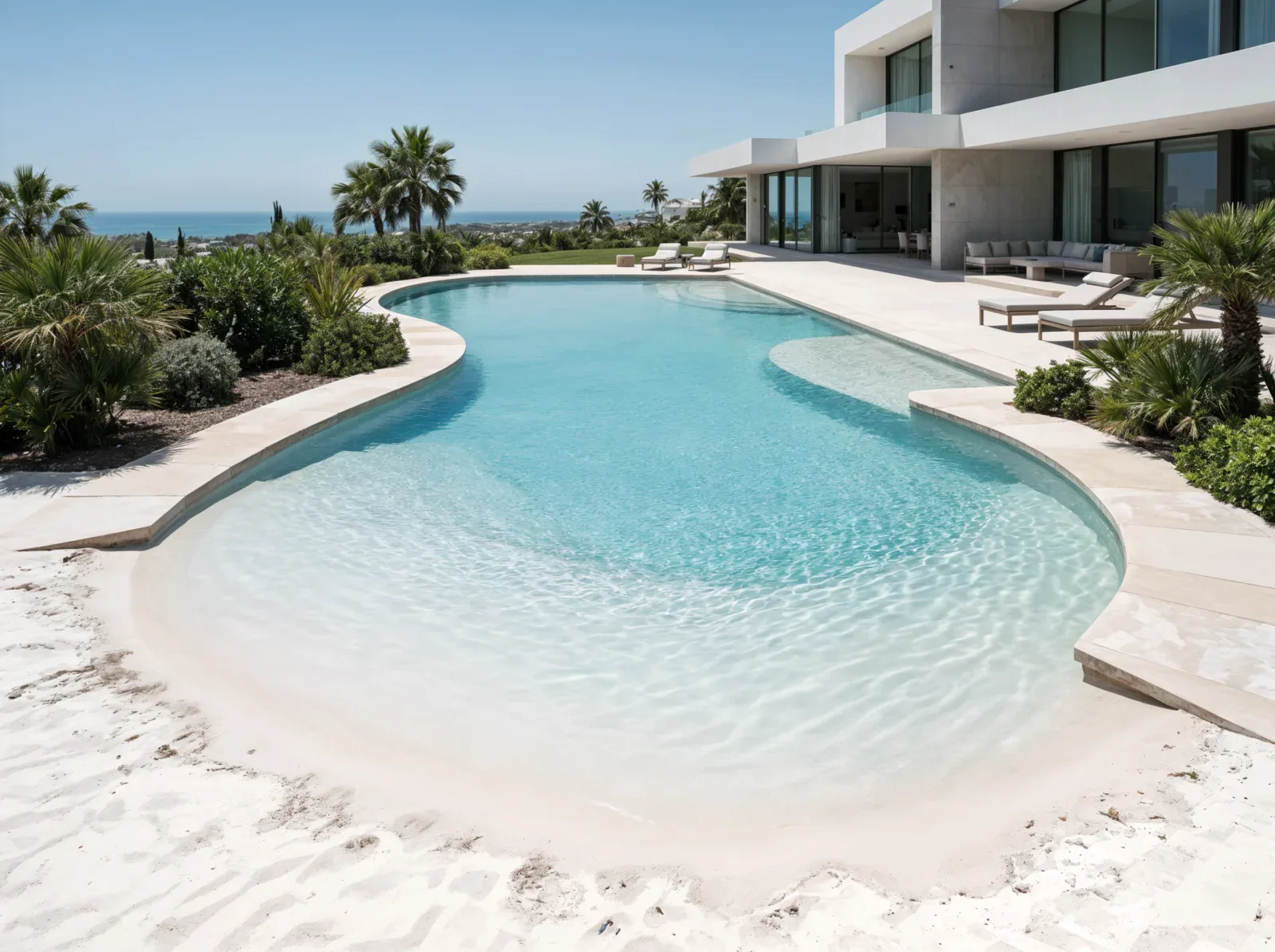
Natural swimming pools utilise biological filtration systems and carefully selected aquatic vegetation instead of conventional chemical sanitisers, creating a balanced, living ecosystem.
This approach reflects a growing interest in environmentally conscious living, perfectly complementing rustic-luxury, organic modern, or traditional Andalusian properties surrounded by extensive natural landscaping. The core advantages include a chemical-free swimming experience, softer water quality, and the seamless integration of local biodiversity.
Designed primarily for holistic wellness, relaxation, and ecological harmony, natural pools transform the garden into a sustainable sanctuary. They offer an architectural dialogue with nature, allowing residents to swim in pure, living water completely integrated within the environment.
The natural swimming pool introduces an environmentally responsive approach to aquatic design within contemporary luxury residential architecture. Conceived as an integrated landscape feature rather than an isolated recreational element, this typology combines biological water purification, hydraulic engineering and architectural composition. Unlike conventional swimming pools, natural systems maintain water quality through biological and physical filtration processes without relying on routine chlorination.
The traditional configuration is organised around two complementary areas: a swimming basin and a regeneration zone. The latter incorporates carefully selected aquatic vegetation and permeable mineral substrates that provide a suitable environment for beneficial microorganisms. Through controlled water circulation, these biological processes contribute to the breakdown of organic matter and the regulation of nutrient levels, limiting excessive algae growth and supporting water quality.
Advances in biological filtration technology have significantly expanded the architectural possibilities of natural swimming pools. Contemporary systems can incorporate independent filtration chambers containing specialised mineral substrates and biological filters, reducing or eliminating the requirement for visible aquatic vegetation. This approach allows architects to maintain the precise rectilinear geometry, refined perimeter detailing and minimalist aesthetic associated with contemporary luxury villas, without compromising the fundamental principles of biological water treatment.
From a construction perspective, the design requires careful coordination between the structural shell, waterproofing membranes, hydraulic circuits and filtration infrastructure. Water circulation must be calculated to minimise stagnant areas and maintain suitable conditions for biological activity. In Mediterranean climates, particular attention must also be given to solar exposure, seasonal temperature variations, evaporation and nutrient management, as these factors directly influence the ecological balance of the system.
DOI+2
The material palette plays a fundamental role in establishing a coherent relationship between the swimming area and its surroundings. Natural limestone, textured porcelain paving, bespoke timber decking and carefully selected aggregates introduce subtle variations in colour and texture. When combined with native Mediterranean vegetation, these materials create a gradual transition between the architectural envelope and the landscaped gardens, softening the distinction between constructed and natural environments.
ROMA Arquitectura Studio, bespoke natural swimming pool architects in Marbella & Sotogrande
One of the principal advantages of natural swimming pools is their reduced dependence on conventional chemical treatments. The absence of routine chlorination provides a bathing experience without the characteristic odour associated with traditionally treated water. Depending on the technical configuration, energy-efficient circulation pumps and reduced chemical consumption can also contribute to lowering the environmental impact of the installation. These benefits nevertheless depend on appropriate system design, regular maintenance and water quality monitoring.
Within the context of luxury residential architecture, natural pools offer considerable potential for creating private wellness environments. Their reflective water surfaces, carefully integrated vegetation and organic material finishes introduce a sense of tranquillity, while their ecological character can contribute to local biodiversity.
Whether expressed through the organic geometry of a landscaped swimming pond or the precise architectural lines of a contemporary biological pool, this typology offers a sophisticated alternative to conventional swimming facilities. Through the integration of architecture, hydraulic engineering and landscape design, the natural swimming pool establishes a distinctive balance between residential comfort, environmental responsibility and the sensory qualities of the Mediterranean landscape.
Luxury natural swimming pools in Sotogrande, San Roque, Marbella, Estepona, Benahavis, Malaga by ROMA Arquitectura Studio
Explore our portfolio, from dramatic infinity pools that blend with the horizon to serene natural aquatic features, where each swimming pool and outdoor living area is designed as an integrated architectural space for luxury homes across Marbella and Sotogrande.
At ROMA Arquitectura Studio, we are English-Speaking architects delivering turnkey projects that combine contemporary design with technical precision for international clients.
Designing a bespoke swimming pool for a luxury residence demands a meticulous curation of its key elements. Every aquatic feature must harmonise with its environment, whether through sharp geometric lines or fluid organic shapes. We carefully define water depths and spatial layouts, ensuring the architecture perfectly balances a refined aesthetic with rigorous sport swimming and relaxed recreational lounging within the surrounding landscape.
Maintaining exceptional water quality in luxury pools requires sophisticated, high-performance filtration systems. While traditional chlorine treatments remain a highly effective standard, contemporary residential projects increasingly favour advanced saline chlorination. Saline systems offer automated disinfection and reliable water hygiene, eliminating the harshness of chemical additives while ensuring a smooth bathing experience.
For an enhanced approach to water purification, advanced ultraviolet (UV) and ozone technologies provide complementary treatment solutions. These systems eliminate pathogens and improve water quality with minimal chemical intervention. Selecting the appropriate purification method is essential to achieving a pristine aquatic environment that balances swimming comfort, material longevity and long-term efficiency.

The specification of an effective filtration and water treatment system is a fundamental consideration in the design of a luxury residential swimming pool. Beyond maintaining water transparency and hygienic conditions, the technical infrastructure directly influences operational efficiency, bathing comfort and the long-term durability of architectural finishes. Within high-end residential projects in Marbella and Sotogrande, these installations should be conceived as an integral part of the architectural and engineering strategy from the earliest design stages.
The primary filtration circuit operates through a continuous process of water collection, mechanical filtration, disinfection and redistribution. Depending on the pool typology, water is collected through integrated skimmers or perimeter overflow channels before being conveyed to a dedicated technical plant room. Mechanical filtration is typically achieved through silica sand, activated glass media or cartridge filtration systems, selected according to the pool volume, anticipated bathing load and hydraulic requirements.
Conventional chlorine treatment remains an effective and widely established method of disinfection. Modern installations can incorporate automated dosing equipment and electronic monitoring of pH and disinfectant levels, maintaining consistent water quality while reducing the need for manual intervention.
An increasingly attractive alternative within luxury residential developments is saltwater chlorination. Through an electrolytic process, dissolved salt is converted into chlorine, providing continuous disinfection within the hydraulic circuit. Although this technology does not eliminate chlorine from the water, it reduces the need for its direct manual addition and can provide a more pleasant bathing experience. Particular attention must be given to the compatibility of metallic fittings, natural stone finishes and surrounding materials with saline conditions.
More advanced installations can incorporate ultraviolet (UV-C) and ozone treatment technologies as supplementary purification systems. Ultraviolet radiation inactivates susceptible microorganisms as water passes through a dedicated treatment chamber, while ozone acts as a powerful oxidising agent, assisting in the breakdown of organic contaminants. These technologies can reduce the demand for conventional chemical treatments and help control the formation of chloramines, although an appropriate residual disinfectant remains necessary.
ROMA Arquitectura Studio, luxury swimming pool architects in Marbella & Sotogrande
From an architectural perspective, the integration of filtration equipment requires careful consideration of technical accessibility, acoustic insulation, ventilation and maintenance. Variable-speed circulation pumps, appropriately dimensioned pipework and optimised hydraulic circuits can significantly improve energy efficiency while reducing operational noise. Locating the plant room discreetly beneath the terrace or within a dedicated service area preserves the visual clarity of the outdoor spaces.
The entire installation can also be connected to the property’s centralised home automation system, allowing remote monitoring of water temperature, filtration cycles, chemical parameters and equipment performance.
Within contemporary luxury villas, the quality of a swimming pool is therefore determined as much by its concealed technical infrastructure as by its visible architectural composition. A carefully engineered filtration and purification strategy establishes a balance between water quality, operational efficiency, material preservation and residential comfort, ensuring that the aquatic environment remains consistent with the architectural standards of the property throughout its service life.
Luxury swimming pools in Marbella, Sotogrande, San Roque, Estepona, Benahavis, Malaga by ROMA Arquitectura Studio, leading architects in the Costa del Sol
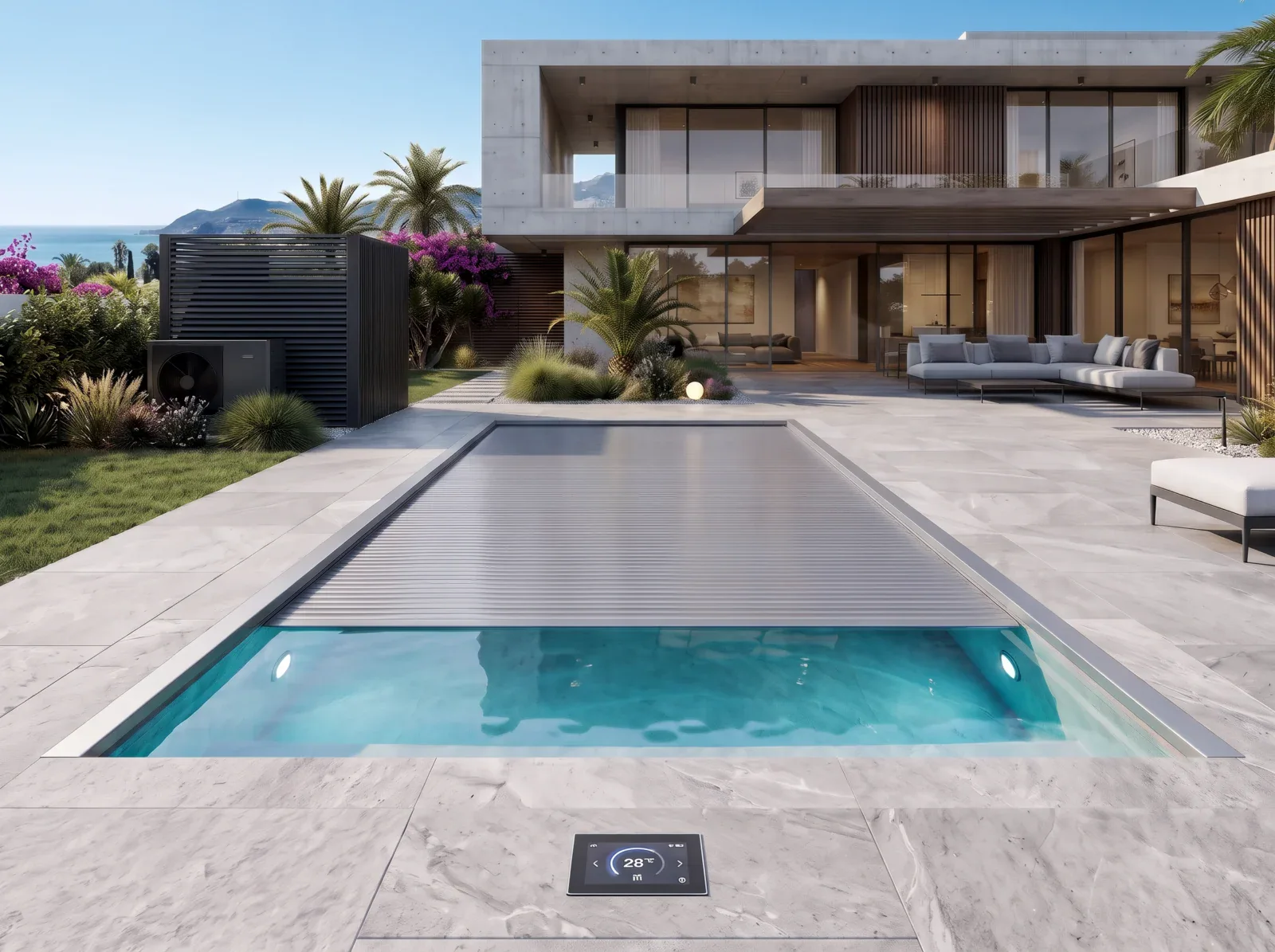
To extend the outdoor living season across Marbella and Sotogrande, integrating a highly efficient pool heating system is essential. Advanced, energy-efficient heat pumps provide comfortable water temperatures year-round. However, thermal performance is incomplete without a tailored pool cover.
Pool covers prevent heat loss, reduce evaporation, and ensure safety. The operating mechanisms can be seamlessly concealed within the pool structure to maintain visual purity, or elegantly integrated into external housings that double as functional seating benches. Bespoke solutions range from durable slatted polycarbonate covers to discreet automated fabric systems.
This comprehensive approach to pool thermal management enhances energy efficiency and bathing comfort while preserving the aesthetic of the swimming pool and its landscape.
Thermal Management and the Architectural Integration of Automated Covers
The integration of an efficient pool heating system is an essential consideration in the design of luxury residential properties where outdoor living forms a central component of the architectural programme. Within the Mediterranean climate of Marbella and Sotogrande, controlled water temperatures can considerably extend the swimming season beyond the summer months, enhancing the functionality of exterior terraces and private wellness facilities.
Contemporary swimming pool heating strategies frequently incorporate high-performance air-source heat pumps, which transfer thermal energy from the ambient air to the water through a dedicated heat exchange system. Unlike conventional direct electric heating, this technology can achieve greater energy efficiency under suitable operating conditions. Inverter-controlled equipment further optimises performance by adjusting its output in response to the pool’s thermal demand, reducing unnecessary energy consumption and fluctuations in water temperature.
The specification of heating equipment must respond to several interconnected factors, including the total water volume, exposed surface area, solar orientation, prevailing winds and anticipated seasonal use. Infinity and perimeter overflow pools require particular consideration, as their exposed collection channels and circulating water can introduce additional sources of thermal loss.
Where the residence incorporates a centralised aerothermal installation or photovoltaic energy generation, pool heating can be coordinated with the broader energy strategy of the property. Dedicated heat exchangers, intelligent temperature regulation and automated operating schedules allow the swimming pool to function as part of an integrated building services network.
However, the effectiveness of any heating installation is closely associated with the specification of an appropriate pool cover. Evaporation represents a major source of heat loss from outdoor swimming pools. A correctly specified cover substantially limits this process, helping to retain accumulated thermal energy, reduce water consumption and minimise the demand placed on heating equipment.
ROMA Arquitectura Studio, luxury zero-edge swimming pool architects in Marbella & Sotogrande
Automated slatted covers manufactured from PVC or polycarbonate offer a particularly refined solution for contemporary residential architecture. Depending on their composition, solar properties and technical configuration, these systems can provide thermal insulation and, in certain cases, contribute to passive solar heating. Reinforced automated fabric covers provide an alternative where the design prioritises a continuous protective surface.
The principal architectural challenge lies in integrating the cover mechanism without disrupting the geometry of the pool. Submerged roller housings can be incorporated beneath entrance steps, within the pool floor or behind a dedicated dividing wall. Alternatively, above-water mechanisms can be concealed within bespoke stone-clad seating benches, transforming a technical requirement into a functional architectural element.
Structural coordination must be established during the initial design phase to accommodate the roller housing, electrical connections, maintenance access and waterproofing details. Where additional protection against accidental falls is required, the cover must be specifically designed and certified for that safety function.
Through the considered integration of heating systems, automated covers and intelligent environmental controls, the swimming pool becomes a more adaptable and energy-efficient component of the residence. This approach extends the usability of exterior living spaces while maintaining the material consistency, geometric precision and understated aesthetic associated with contemporary luxury villas.
Bespoke zero-edge swimming pools in Sotogrande, San Roque, Marbella, Estepona, Benahavis, Malaga by ROMA Arquitectura Studio, luxury architects and interior designers in the Costa del Sol
The interior finish of a swimming pool defines its water colour, texture, and relationship with the surrounding architecture.
Traditional glass mosaic tiles (gresite) from manufacturers such as Hisbalit and Ezarri offer exceptional design versatility, allowing for subtle colour gradients and long-lasting durability. Alternatively, large-format porcelain tiles, like those by Rosa Gres, provide a contemporary, monolithic aesthetic while simplifying maintenance and establishing a seamless visual continuity with the pool coping and surrounding terraces.
Whether complemented by porcelain paving, natural stone, or timber decking, a well-considered material selection is essential to seamlessly connect the swimming pool with the wider outdoor living spaces, ensuring a cohesive composition that flawlessly reflects the property’s distinctive architectural style.

The specification of interior and perimeter finishes is one of the most influential architectural decisions in the design of a luxury residential swimming pool. Beyond their decorative function, these materials determine the chromatic perception of the water, its reflective qualities, the tactile experience of the bathing environment and its visual relationship with the surrounding architecture. Material selection must therefore respond to both aesthetic considerations and the demanding technical conditions associated with permanent water immersion and exterior exposure.
Traditional glass mosaic tiles remain a widely established solution within high-end residential architecture. Specialist manufacturers such as Hisbalit and Ezarri offer extensive collections of colours, textures and chromatic combinations, allowing architects to develop bespoke compositions and subtle tonal gradients. The small-format geometry of glass mosaic tiles is particularly suited to complex surfaces, curved profiles, submerged seating areas and integrated hydromassage facilities. Their low water absorption and resistance to chemical exposure also make them suitable for long-term aquatic applications when correctly installed.
Large-format porcelain tiles represent an alternative particularly well suited to contemporary minimalist architecture. Specialist manufacturers such as Rosa Gres offer coordinated ceramic solutions that allow the same material language to extend across the interior pool lining, perimeter copings, submerged steps and exterior terraces. The reduced number of visible joints creates a more continuous surface, reinforcing the monolithic character of the architectural composition while simplifying routine cleaning.
The chromatic specification of the internal lining directly influences the perceived colour of the water. Light ivory and sand-toned finishes generally produce delicate turquoise reflections, complementing the natural luminosity of the Mediterranean environment. Grey and anthracite finishes introduce greater visual depth and contrast, while green and earth-toned surfaces establish a more organic relationship with landscaped gardens. Water depth, solar orientation and atmospheric conditions further influence these visual characteristics throughout the day.
Natural stone can also be incorporated into the pool design, particularly within perimeter copings, terraces and selected submerged architectural elements. Limestone, granite and other suitable stone varieties introduce texture and material authenticity, although their porosity, chemical resistance and dimensional stability must be carefully assessed in relation to the intended application.
From a construction perspective, the performance of any pool finish depends upon the correct preparation of the structural substrate, waterproofing membranes, adhesive systems and grouting compounds. Movement joints must accommodate structural and thermal variations, while exposed pedestrian surfaces, submerged steps and shallow bathing areas require appropriate slip-resistant finishes.
ROMA Arquitectura Studio, luxury zero-edge swimming pool architects in Sotogrande & Marbella with turnkey service
Particular attention should be given to the detailing of infinity edges, overflow channels and concealed drainage systems. Bespoke ceramic or natural stone components allow these technical elements to be integrated discreetly into the overall material composition, preserving the continuity of the architectural lines.
The surrounding hard landscaping can further reinforce this relationship through coordinated porcelain paving, natural stone terraces or timber decking. By maintaining consistency in colour, texture and geometric alignment, the transition between the residence, swimming pool and landscaped gardens becomes increasingly cohesive.
Within luxury villas in Marbella and Sotogrande, the architectural specification of swimming pool finishes is ultimately an exercise in balancing visual refinement, technical performance and long-term durability. When appropriately resolved, the material palette transforms the aquatic environment into a natural extension of the architectural identity of the residence.
Luxury natural swimming pools in Sotogrande, San Roque, Marbella, Estepona, Benahavis, Malaga by ROMA Arquitectura Studio

The final architectural layer of a luxury swimming pool involves the precise integration of functional and sensory accessories. Custom submerged seating areas and seamlessly integrated jacuzzis offer comfort and relaxation while preserving the pool’s functionality. To enhance the athletic experience, advanced counter-current swim jets are a highly effective addition.
Visual drama is achieved through minimalist architectural waterfalls and underwater LED lighting, transforming the water into a dynamic sculptural element at night. Bespoke outdoor showers combine practicality with design, blending into the surrounding landscape without demanding visual prominence.
All these swimming pool extras elevate the overall experience while preserving flawless architectural cohesion within the exclusive outdoor living spaces of Marbella and Sotogrande.
The incorporation of complementary swimming pool features within luxury residential architecture requires a carefully considered approach that extends beyond the specification of conventional recreational accessories. Each additional element should respond to the spatial organisation, material palette and technical infrastructure of the property, contributing to a comprehensive outdoor environment that integrates relaxation, physical activity, wellness and sensory experience.
Submerged seating areas and shallow sunbathing platforms represent particularly versatile architectural interventions. Integrated directly into the reinforced concrete shell, these features establish differentiated bathing zones without interrupting the visual continuity of the water surface. Generously proportioned underwater benches provide areas for relaxation, while shallow platforms can accommodate partially submerged loungers, creating a direct relationship between the swimming pool and the surrounding sun terrace.
Integrated hydromassage facilities introduce an additional wellness dimension. Bespoke spas can be incorporated within the primary pool geometry or designed as independent aquatic volumes connected through a shared architectural composition. Strategically positioned hydrotherapy jets, air injection systems and ergonomic submerged seating provide targeted massage functions. Independent hydraulic circuits and temperature controls allow these facilities to operate according to their specific thermal and functional requirements.
For residences where physical training forms part of the domestic programme, counter-current swimming systems offer considerable functional advantages. High-performance adjustable swim jets generate a controlled water current against which the swimmer can exercise continuously, even within pools of relatively compact dimensions. Concealed turbine systems and discreetly integrated nozzle assemblies allow this technology to be incorporated without compromising the clarity of the pool’s architectural geometry.
Water features provide another opportunity to explore the sensory qualities of the exterior environment. Linear architectural waterfalls, concealed spillways and minimalist water blades introduce movement, sound and changing reflections into the landscape. These elements can be integrated within natural stone retaining walls, freestanding geometric volumes or cantilevered architectural structures. Their design requires careful consideration of hydraulic flow rates, acoustic performance, splash zones and water consumption.
Architectural lighting plays an equally important role in defining the nocturnal character of the pool. Recessed underwater LED luminaires, integrated linear lighting and discreet illumination beneath submerged steps can emphasise the geometry of the aquatic volume while improving visibility and orientation. Warm-white lighting creates a restrained and sophisticated atmosphere, particularly when coordinated with the illumination of exterior terraces, architectural façades and landscaped gardens.
Complementary installations, such as bespoke outdoor showers, can be expressed through minimalist stainless steel structures or integrated within stone-clad architectural walls. Within coastal environments, the specification of metallic components must account for atmospheric salinity, chemical exposure and long-term corrosion resistance.
The successful incorporation of these elements requires early coordination between the architectural design, structural engineering and building services. Dedicated hydraulic circuits, concealed pipework, electrical connections and accessible maintenance points must be anticipated before the construction of the pool shell. Integration with the property’s centralised home automation system can subsequently provide intuitive control over lighting scenes, water features, hydromassage functions and operating schedules.
In contemporary luxury villas across Marbella and Sotogrande, swimming pool accessories should not be perceived as isolated additions, but as integral components of the overall architectural concept. Through precise technical coordination, considered material selection and discreet detailing, these features transform the swimming pool into a multifunctional private wellness environment while preserving the aesthetic coherence of the residence.
ROMA Arquitectura Studio, luxury infinity swimming pool architects in Sotogrande & Marbella with turnkey service
At ROMA Arquitectura Studio, we are an English-speaking architectural practice specialising in the design and construction of bespoke swimming pools for luxury residential properties in Marbella, Sotogrande and throughout the Costa del Sol. Our expertise encompasses a wide range of pool typologies, including zero-edge and perimeter overflow pools, traditional skimmer systems, infinity pools and natural swimming pools with biological filtration. We approach each project from a comprehensive architectural perspective, carefully considering the site’s topography, structural requirements, hydraulic infrastructure, energy efficiency, material specification and integration with the surrounding landscape. In addition to design and construction, we manage the entire legal, technical and administrative process associated with building a swimming pool in Spain. Our services include assessing planning regulations, verifying development restrictions, preparing technical documentation, obtaining the required professional endorsement (visado) from the Architects’ Association and handling municipal building licence applications. We also coordinate specialist contractors, supervise construction works and oversee the execution of architectural and technical details. By providing a complete architectural and project management service in English, we simplify the complexities of Spanish planning procedures for our international clients, ensuring that each swimming pool is developed in accordance with applicable regulations whilst meeting the highest standards of design, construction quality and residential comfort.
Swimming pool architects in Sotogrande, San Roque, Marbella, Estepona, Benahavis, Malaga, a leading architectural practice in the Costa del Sol
Let’s craft together the home you have always envisioned. Tell us about your vision, and let us help you bring it to life.